Spain, April 14, 1931. The Second Republic is born. From the beginning, the writer Miguel de Unamuno is considered one of the ethical pillars of the new regime. Five years later, on December 31, 1936, a few months after the outbreak of the Spanish Civil War (1936-39), Unamuno dies at his home in Salamanca, capital of the rebel side, led by General Francisco Franco, and main center of dissemination of its propaganda apparatus.
February 28 is Deniz Gezmiş's birthday… He would have been 75 years old today; but it only lived for 25 years, and in those 25 years, it had an impact that spanned 75 years. When you have a 25-year-old son, one feels better, what was done to him...
Atsushi Sakahara, a victim of the 1995 sarin gas attack in Tokyo's subway system, travels with Hiroshi Araki, an executive of Aleph (formerly Aum Shinrikyo), the attack's perpetrators, visiting their respective hometowns and the university they both attended. Conversations unfold, building intimacy: we learn why Araki joined the infamous organization led by Shoko Asahara and why, still, Araki remains an executive member of the cult, even though he was not directly involved in any of the crimes.The beginning of a friendship, a trip for redemption, or the confirmation that each human has to go their own way.
In 1570 B.C., Rome was a marsh, the Acropolis an empty rock, but Egypt was 1,000 years old. The pyramid-builders were gone, yet Egypt still awaited its New Kingdom, an empire forged by conquest and remembered for eons. EGYPT'S GOLDEN EMPIRE comes to life through letters and records evoking the passion and riches of a time when Egypt was the center of the known world, its Pharaohs called gods, and great cities, temples and tombs built.
In northern Peru, the unprecedented archaeological discovery of the largest known mass child sacrifice in the world opens the doors to the kingdom of Chimor. This international archaeological investigation carried out like a criminal investigation reveals the mysteries of the last civilization of the Andes before the arrival of the Incas.
The Crown Prince of Malabar dallies with Rosita whilst his people suffer at the hands of cruel Portuguese colonists. Whilst voyaging on a Portuguese ship, the Prince is captured by patriots who are rebelling against the foreign invaders. They are led by a girl called Nisha known as "The Falcon" ("Baaz"). The Prince conceals his identity from Nisha and a romance blossoms between them. Together, they rouse the people, rout the Portuguese and free the Kingdom - but can a commoner marry a Prince ?
In 19th century Victorian England, Mrs. Isabella Beeton produced what became an essential book for housewives of the day. She was married at a relatively young age to Sam Beeton, a publisher of books and magazines on a variety of subjects. Not someone to sit at home in the traditional role of a housewife, Mrs. Beeton started work in her husband's business, initially as an editor correcting English but then writing some of the columns herself. It as at this point that she developed an idea for a cookbook and Mrs. Beeton's Book of Household Management was born. Her life was not an easy one however. The publishing business went bankrupt, she lost two children at a young age and had several miscarriages. She died at the age of 28.
Leipzig, December 1734: Christmas brings the Bach family together. The first snow has fallen and the children Gottfried and Elisabeth are delighted about the arrival of their older brothers Friedemann and Emanuel. The Thomaskantor has retired to his music room. Anna Magdalena supports her husband, as there are only a few days left and his latest work, the six-part "Christmas Oratorio", must be finished on time. It is awaited with suspicion by the city council and the gentlemen of the consistory, who have long found Bach's waywardness a thorn in their side and fear that, after the premiere of the St. Matthew Passion a few years earlier, the St. Thomas Church will once again be filled with "operatic" music. With the oratorio, Johann Sebastian Bach hopes that he will finally become court composer in Dresden. And, as always, he demands that all members of the family join forces to help him. But differences of opinion are increasingly delaying the completion of Bach's most famous work.
A look at the intimacy of the US writer Ernest Hemingway (1899-1961), a man infinitely more complex than his public image suggested, through the story of his relationship with his four wives.
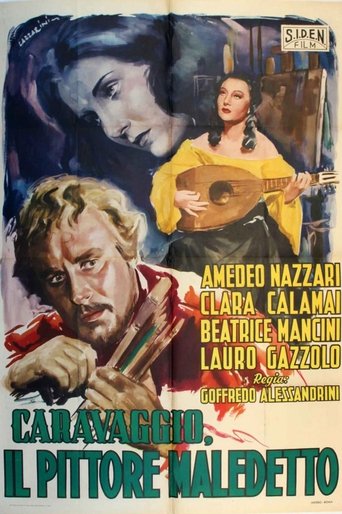
Caravaggio, il pittore maledetto is a 1941 Italian historical drama film directed by Goffredo Alessandrini and starring Amedeo Nazzari, Clara Calamai and Lamberto Picasso. Nazzari portrays the painter Caravaggio as a wayward genius. It was one of his favourite screen roles.
Fourth Week Films and the New Orleans Jesuit Province present Xavier, a new PBS-style documentary film on the life of the famed 16th-century Jesuit missionary Francis Xavier. Narrated by Liam Neeson, Xavier tells the missionary's compelling story through dramatizations, interviews, contemporary location shots, paintings and engravings, maps, and most importantly, the extant letters of Xavier. The film features interviews with distinguished scholars of Jesuit and Renaissance history including Ingrid Rowland (Notre Dame University), Andrew Ross (University of Edinburgh), Lourdes del Costa (University of Goa, India), Anthony Ucerler, SJ (Jesuit Historical Institute in Rome), Gauvin Bailey (Clark University) and John O'Malley, SJ, (Weston Jesuit School of Theology).
A tale of hate in a town in the Venezuelan Andes where the conflicts and passions of those who live enclosed in the mountains make violence an inevitable destiny.
The story of the siege and eventual relief of British soldiers garrisoned at Lucknow during the 1857 Indian Rebellion. Only a fragment of the original film remains.
The rejection of the project for a new, more socially just constitution by the Chilean people in 2022 has reignited the conflicts that have plagued the country for five decades. On September 11, 1973, in a bloody military coup, General Pinochet ended the socialist revolution launched by President Salvador Allende, legitimately elected in a democratic election. The subsequent dictatorial regime with fascist features brought great violence and terror to the Chilean people. The accompanying neo-liberal economic system, which made the country one of the richest in the region, led to an ever-widening social gap in society, which in turn fell into a kind of passivity. In 2019, long after the dictator was voted out of office and the democratization that followed, a new social movement is shaking the prevailing order. From Allende's socialism to Pinochet's fascism, this historical fresco in documentary form returns to the origins of the rupture.
More than two decades after it left our screens, BBC Two’s iconic and much-loved music documentary series, Rock Family Trees, is back for a one-off special. The iconic music documentary series returns to examine the real story behind the birth of Britpop and how a handful of like-minded musicians, struggling to find an authentic voice, would pave the way for a revolution in British music. It is an intricately connected story of three of the biggest bands of the 1990s – Suede, Elastica and Blur – and how, for a brief moment in the middle of that decade, they changed British music forever, kickstarting a movement that still reverberates to this day.
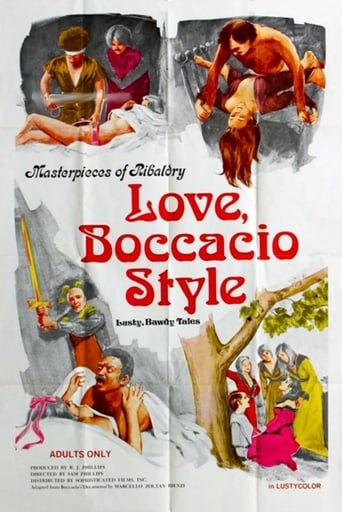
Four ribald short stories set in the Medieval age, each with a ribald bent. The tawdry tales involve a chastity belt, a man pretending to be deaf-mute to gain access to virgins in a convent school and an adulteress on death row who uses her charms to talk a magistrate out of her punishment.
Documentary revealing the inner workings of the world's most powerful intelligence organization, with unprecedented access to America's spy network, all 12 living CIA directors and top agency operatives, who talk candidly about torture, secret prisons, drone warfare, alleged assassinations and the constant threat of attack, which begs the question: how far should America go to keep us safe?
A caravan guarded by Roman soldiers comes across a woman bound to a stake and left to die. A wealthy merchant who hired the caravan is against taking The Woman along, but the commander of the soldiers, Verrus, overrules him. Verrus tries to get friendly with her, promising all kinds of wealth for her favors. The caravan encounters a group of Jdean refugees fleeing from King Herod's orders to kill all male children. They are on their way to Egypt with a male child with them. The Merchant begins to ponder the reward that would be paid by the King and orders The Woman to seduce a Roman guard to enable the messenger to get away. When the King's soldiers show up, Verrus refuses to surrender the refugees. Then the sand hits the fan.
The war units of the Hun Emperor Mete Han and the Chinese Emperor Gao-Zu, the father of the turan tactic used by the Turks for centuries, come face to face in the Battle of Baideng. The war genius Mete Han was going to surround the Chinese with an unexpected war tactic and inflict a heavy defeat on them.
Activate your FREE Account!
You must create an account to continue watching