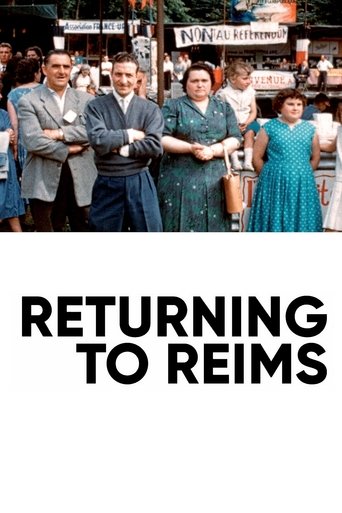
An intimate and political history of the French working class from the early 1950s to the present day.
Kirill Ivanovich Shchelkin is not well-known among the most honored scientists of the Soviet Union. Meanwhile, Shchelkin was one of the main creators of atomic and hydrogen bombs, one of the founders of modern cosmonautics, three times a hero of Socialist labor, a man whom Igor Kurchatov called ‘The Godfather of the atomic bomb.’ The scientific research of Shchelkin and his colleagues, without exaggeration, saved the world from a third world war and ensured a peaceful life not only in Russia, but for all mankind.
Jewish family history is reconstructed in this documentary about the traces of German terror in Eastern Europe during World War II where in which is about the attic of a peasant's home where her family's parents and relatives hid in squalor during the war for two frightening years hid, and then spent most of their lives afterwards trying to forget what happened. Yet their children somehow knew what their parents went through. Deciding to confront her personal demons, Goodstein went back to Poland with her aunt and a group of cousins to meet the woman who sheltered her family.
The musical takes us back to Aalst in 1888. The population works in appalling conditions in the factories. They are abused and exploited by the wealthy factory directors.
In 1988, after much cunning political maneuvering, Loïk Le Floch-Prigent and Alfred Sirven become the chief executives at Elf. They discover a company that runs on kickbacks: in exchange for the oil rights, Elf makes handsome but discreet payoffs to the leaders of African nations. With the tacit complicity of President Mitterrand, and with eventual political and personal interests in mind, the new management takes charge of the slush fund. Within months, Sirven, Le Floch-Prigent and his wife Fatima Belaïd fill their pockets with more than they could ever have imagined.
Sohrab, a provincial young writer, is lost in the desert on the way to Tehran to get a publication license for his book on old Persian poetry, but the trip involves some bizarre events.
Set in post-independent India, this film narrates the story of a naive villager who has warped ideas about an atrocious communal group called Razzakars and wishes to join it until he realises what they are capable of.
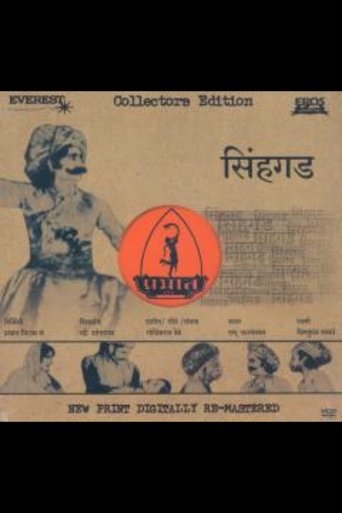
Udaybhanu captures Kamlakumari who is planning to commit Sati and brings her to his fort in Kondana. Tanaji Malusare prepares to attack the fort with fifty soldiers. He manages to scale it but is killed in the battle with Udaybhanu. Chatrapati Shivaji Maharaj arrives and wins the fort but he is despondent on losing his most trusted Lieutenant.
The film is about the sailors who fought on torpedo boats in the Great Patriotic war.
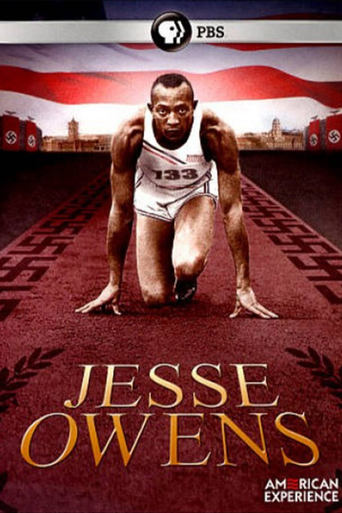
Jesse Owens details Jesse's early career; describes Adolf Hitler s outsized ambitions for the 1936 Olympics; explores the movement in Western democracies to boycott the event; and explains the pressures on Owens to attend. The film also explores why, despite his success in Germany, Owens struggled to find a place for himself in a United States that was still wrestling with its own deeply entrenched racism.
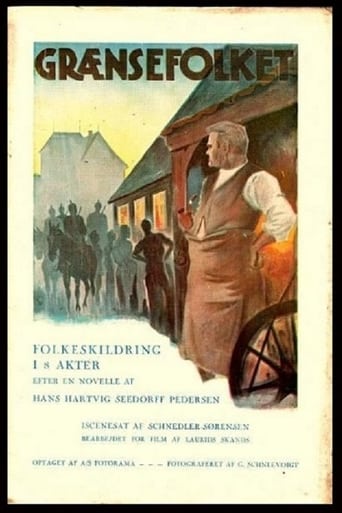
FRAGMENT | The Family Steffensen lives on a farm in Southern Jutland. The area has been under German rule for 60 years, when WW I suddenly breaks out. The possibility of regaining the lost land brings new hope to the border people, but the poor Steffensen's farm is threatened by compulsory sale. Secretly, the youngest son runs off to Denmark to get money, but he doesn't make it back before his parents are forced out of their home. Surprisingly, the family's farm laborer has come into money and acquires the farm. The restored film is only a fragment of the original film. The fragment consists of the film's ending, where it's exposed who the mystical farm laborer really is. (stumfilm.dk)
The bitter sweet relationship between a young singer and her musician mentor set against the backdrop of the jazz clubs of Mumbai and the musicians from Goa during the 60s. In the 1960s Lawrence Vaz a young Goan musician playing in the nightclubs of Mumbai, returns to Goa to find a singer for his band. He meets a promising young singer Dona Pereira and convinces her parents to let her sing in his band. While Lawry moulds the impressionable young Dona into a talented singer, they fall deeply in love. The romance between musician and singer turns into a bitter battle for love and acceptance. Based on actual events this quasi-biographical film is a tribute to a great Goan , yet barely acknowledged, legacy. Musicians who once upon a time set the jazz clubs of Mumbai on fire and actually shaped the music of Bollywood cinem
Bologna, 1976. The paths of two aimless young friends intertwine with those of Radio Alice, a pirate radio politically aligned with the leftist student movement.
As incomparable in swordplay and wordplay as he is, the gallant soldier, philosopher, and poet Cyrano de Bergerac is as timid as a schoolboy before the fair Roxanne. Derek Jacobi delivers an electrifying award-winning portrayal of Rostand's legendary log-nosed swordsman in this highly acclaimed production from the world's premier theatre troupe, The Royal Shakespeare Company. The bold Cyrano boasts he can defeat a hundred men in a swordfight, but because of his grotesque nose lacks the confidence to court the woman he loves. Yet so entranced with Roxanne is Cyrano that he uses the eloquence of his poetry to woo her for a rival.
Since the contemporary turn of the century short subjects of Georges Melies, the first French-made film to discuss the long taboo topic of the Dreyfus Case.
Actor becomes Hitler's valet, murders him, takes his place and ruins Nazi Germany's war efforts.
July, 1941. After the beginning of the German invasion, an Italian soldier, a veteran of the colonial wars, is sent to the Soviet front. As he remembers the fairy tales his Russian mother used to tell him, the train he is travelling in crosses Europe on its way to the vast Ukrainian plains, where the enemy and a cruel winter await him… (Based on the experiences of several Italian soldiers.)
Today, few people's clothes attract as much attention as the royal family, but this is not a modern-day paparazzi-inspired obsession. Historian Dr. Lucy Worsley, Chief Curator at Historic Royal Palaces, reveals that it has always been this way. Exploring the royal wardrobes of our kings and queens over the last four hundred years, Lucy shows this isn't just a public fascination, but an important and powerful message from the monarchs. From Elizabeth I to the present Queen Elizabeth II, Lucy explains how the royal wardrobe's significance goes far beyond the cut and color of the clothing. Royal fashion is, and has always been, regarded as a very personal statement to reflect their power over the reign. Most kings and queens have carefully choreographed every aspect of their wardrobe; for those who have not, there have sometimes been calamitous consequences. As much today as in the past, royal fashion is as much about politics as it is about elegant attire.
Was the legendary playwright William Shakespeare really the author of his acclaimed plays? Or was he just a straw man working for a secret society? Norwegian organist and researcher Petter Amundsen claims to have a solid theory on the subject. Shakespearean scholar Robert Crumpton decides to travel to Norway to meet him.
Hollywood, 1927. The talkies have just been born and the big movie studios, responding to the demand of millions of Spanish speakers, begin to produce Spanish versions of their most ambitious productions. It is when a group of Spanish directors, screenwriters and actors decide to settle in Los Angeles in order to make a name for themselves among the biggest stars.
Activate your FREE Account!
You must create an account to continue watching